Start with your own specification
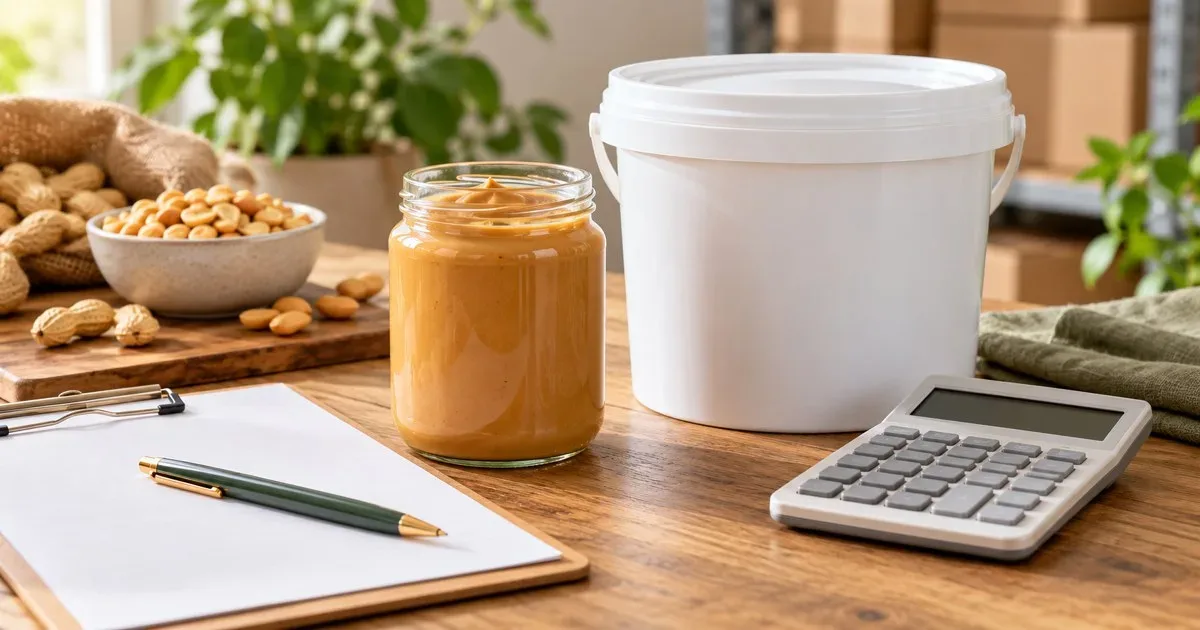
The quickest way to compare suppliers is to send each of them the same written brief. Without one, every factory quotes a slightly different product and the prices cannot be compared fairly. A one-page specification also tells suppliers that you are a serious buyer, which usually brings faster and more detailed answers.
Texture, recipe and claims
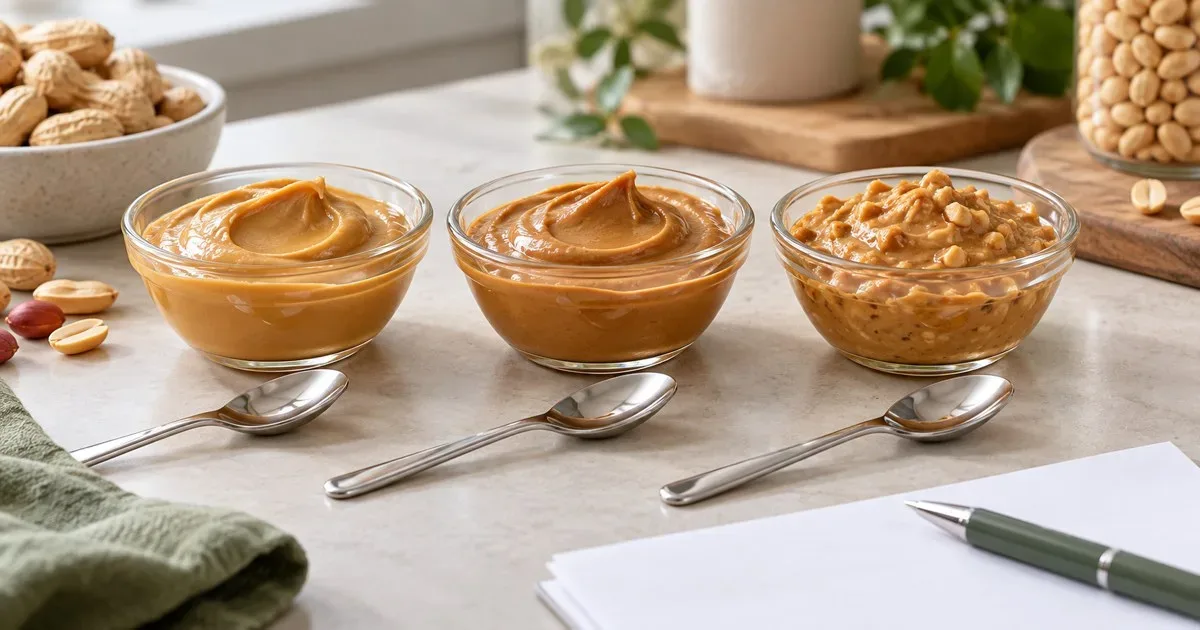
State whether you need smooth, crunchy or extra-crunchy texture, and whether the recipe is 100% peanuts or includes salt, sugar, honey, cocoa or a stabiliser that stops the oil from separating. If your label will carry claims such as "no added sugar" or "high protein", say so at the start: the supplier has to formulate and test against those claims, and the wording must meet the labelling rules of your market.
Pack format and labelling
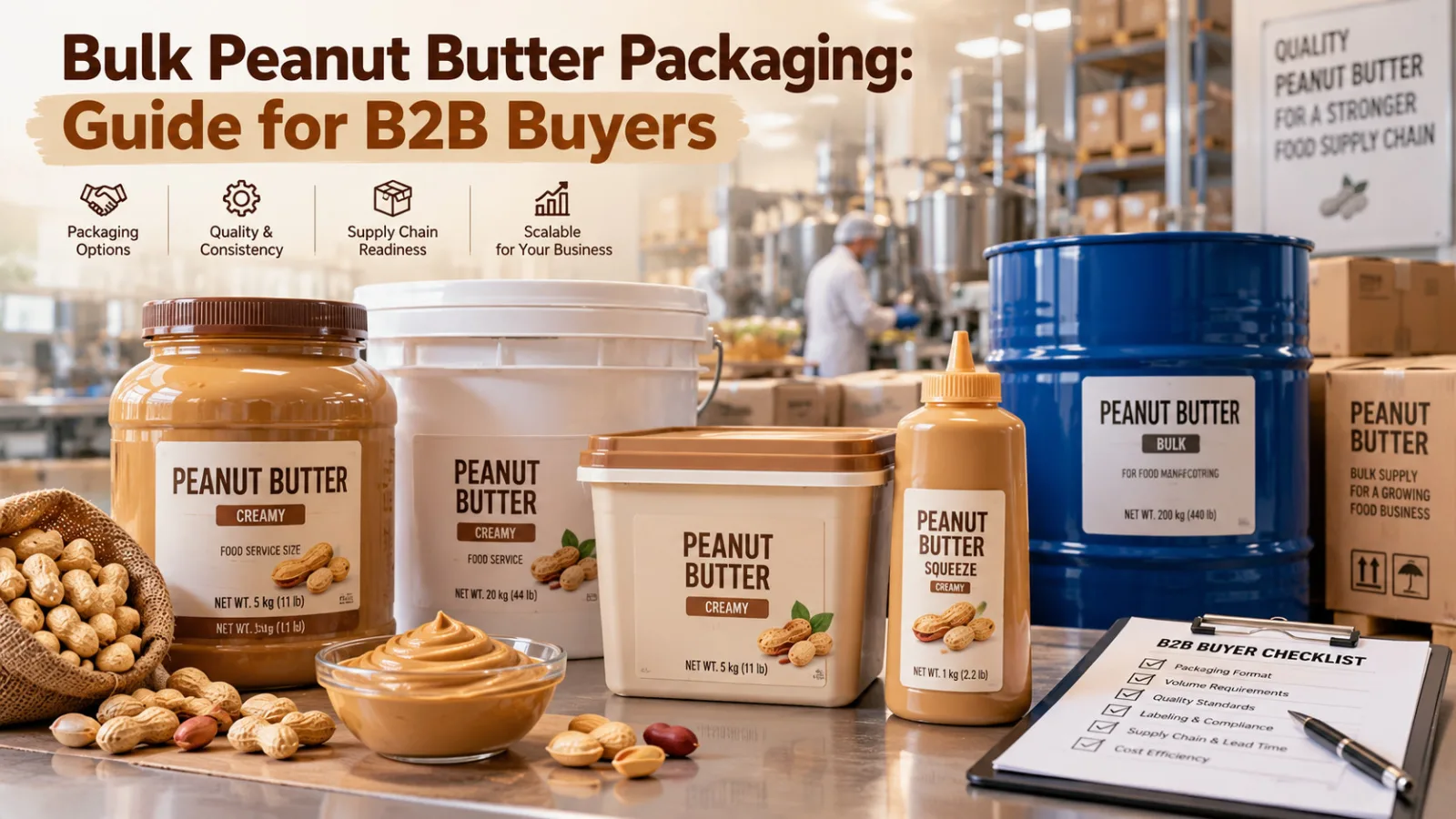
Bulk buyers usually choose between pails, buckets and drums for food service or re-packing, or finished retail jars under their own brand. Tell the supplier the fill weight, container type, closure, carton configuration and whether labels are printed by them or supplied by you. Pallet and container loading patterns matter as well, because they decide how many units fit in a 20-foot or 40-foot container.
Destination market rules
Food law differs from country to country. Allergen declarations, permitted additives, contaminant limits and label language are all set by the importing country. Share the destination market at the first contact so the supplier can confirm whether they already ship there and which documents and tests are normally needed.
Check food-safety certification and audits
Certification is the first filter for export food buyers. A recognised scheme shows that the factory runs a documented food-safety management system and is audited against it by an independent body.
Which certificates matter
Many retailers and importers ask for a scheme benchmarked by the Global Food Safety Initiative (GFSI), such as BRCGS or FSSC 22000, both built on HACCP principles. Religious certifications such as Halal and Kosher are needed for some markets and customers. In India, a manufacturer also needs an FSSAI licence, and exporters of food products are usually registered with APEDA. The United Foods facility in Talaja, Gujarat holds BRC, HACCP, FSSC 22000, Halal and Kosher certification and is registered with FSSAI and APEDA.
How to verify a certificate
Ask for a copy of each certificate and check the company name, site address, scope and expiry date. The scope should cover peanut butter or nut paste manufacturing at the site that will actually produce your order. Most certification bodies keep public directories where you can confirm that a certificate is valid. If a supplier cannot share certificates, or the address on the certificate does not match the factory, treat it as a warning sign.
Look at raw-material sourcing and traceability
Peanut butter is a simple product, so its quality depends heavily on the peanuts. Ask how the supplier buys, stores and prepares its raw material.
Origin of the peanuts
A supplier located in a peanut-growing region can buy close to the farm, which shortens transport and makes it easier to select good lots. Gujarat is India’s largest peanut-growing state, and United Foods is based in Talaja, in the heart of that region. Ask which varieties and crop years are used and how the supplier handles the natural differences between harvests.
Roasting, blanching and sorting
Good practice includes cleaning, roasting to a controlled colour, blanching to remove the skins and sorting out damaged or discoloured kernels before grinding. Sorting is an important control point for aflatoxin, a natural toxin produced by moulds on damaged or poorly stored nuts. Ask what sorting the factory uses and how often aflatoxin is tested.
Lot traceability
Every batch of finished product should be traceable back to the raw-material lots it came from. Ask the supplier to show how the batch code on a jar or drum links to production records. Good traceability makes it possible to investigate a complaint quickly and, if it is ever needed, to limit a recall to the affected batches only.
Quality control and laboratory testing
A reliable supplier tests raw materials, monitors the process and checks finished product before it leaves the factory. Ask for the finished-product specification so you know which parameters are tested and what the limits are.
What a Certificate of Analysis should show
A Certificate of Analysis (COA) is issued for a batch and normally reports physical, chemical and microbiological results, for example moisture, fat or free fatty acids, aflatoxin and pathogens such as Salmonella. Compare each result with the specification and with the limits that apply in your market. For a first order, many buyers also ask an independent laboratory to test the samples or the shipment.
Samples and pre-shipment checks
Always taste and test samples from a normal production run before placing a full order, and keep reference samples so later shipments can be compared against them. For large orders you can also ask for pre-shipment photographs, a third-party inspection, or both.
Export documentation and logistics
An experienced exporter prepares the paperwork that lets your shipment clear customs without delays. Confirm early who prepares which document and how long each one takes.
Documents you will usually need
- Commercial invoice and packing list
- Bill of lading or air waybill
- Certificate of origin, which may also support reduced duty under a trade agreement
- Certificate of Analysis for the batch shipped
- Health or sanitary certificate where the destination requires one
- Halal or Kosher certificates if your customers ask for them
Requirements change from time to time, so check the current list with your customs broker or import authority before each new market.
Incoterms and shipping
Agree the Incoterm, for example FOB or CIF, in writing so both sides know who pays freight and insurance and where the risk passes. Ask which port the supplier ships from and the usual transit time to your port. Peanut butter is shelf-stable, but containers should not stand in strong heat for long periods, so plan loading and transit with that in mind.
Packaging, minimum order and lead times
Bulk packs or retail packs
Bulk formats such as pails, buckets and drums suit bakeries, food manufacturers and re-packers. Retail jars suit importers and brands that sell directly to shops. United Foods packs peanut butter in sizes from 200 g jars up to 200 kg drums, so one supplier can cover both channels.
Minimum order quantities and planning
The minimum order quantity (MOQ) usually depends on the pack format, the recipe and whether printed labels or custom jars are needed. Private-label orders take longer than standard products, because artwork, label approval and packaging materials must be arranged first. Share a forecast, even a rough one, so the supplier can plan raw-material buying and production capacity for you.
Red flags to watch for
- Prices far below other quotations for the same specification, with no clear explanation.
- No certificates, or certificates in the name of a different company or site.
- Reluctance to send samples or a Certificate of Analysis.
- Vague answers about where the peanuts come from or how aflatoxin is controlled.
- No written specification or contract terms, only verbal promises.
A simple supplier evaluation checklist
Score each shortlisted supplier on the same points. A table like the one below keeps the comparison objective and makes it easy to explain your choice to colleagues.
| Area | What to ask for | Good sign |
|---|---|---|
| Certification | Copies of BRCGS or FSSC 22000, HACCP, Halal and Kosher certificates | Valid, site-specific, scope covers peanut butter |
| Raw material | Origin, sorting and aflatoxin controls | A clear process with test records |
| Quality | Product specification and batch COA | Results within the limits for your market |
| Samples | Samples from a normal production run | Taste and texture match the specification |
| Export | Document list, shipping port and transit time | Experience with your destination |
| Commercial | MOQ, lead time, payment terms and Incoterm | A written quotation with all terms |
Conclusion
Choosing a bulk peanut butter supplier is mostly about reducing risk: risk to food safety, to your brand and to your delivery schedule. Start with a clear specification, verify the certificates, ask how the peanuts are sourced and tested, and confirm the export paperwork before you sign. Then test samples and begin with a trial shipment before you scale up.
If you would like to compare United Foods against your own checklist, our export team can share certificates, product specifications and samples for your market.