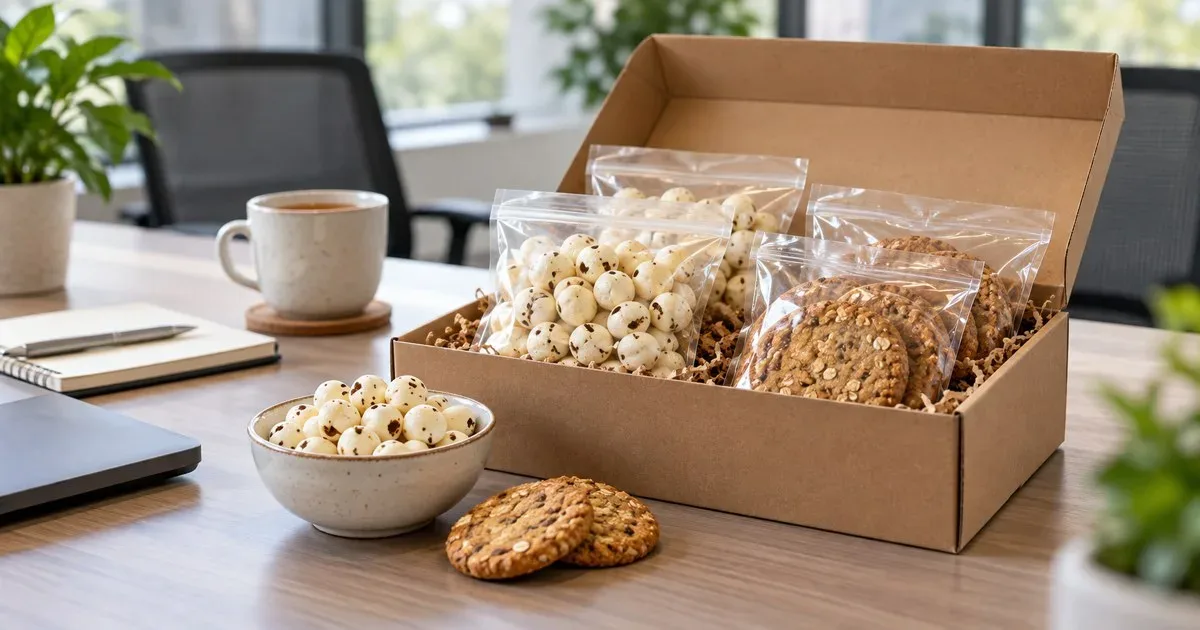
A snack box for a team meeting and a weekly pantry refill are different purchases. Planning office snack boxes starts with deciding who will receive them, when they will be used and how the food will be served. A useful assortment gives people a choice while keeping quantities, storage and repeat ordering manageable.
This guide helps office administrators, purchasing teams and event coordinators prepare a practical bulk snack brief. It focuses on makhana and cookies from United Foods' current range. The box arrangements and quantities below are planning suggestions; confirm individual packing and any box-assembly service with the supplier before ordering.
Choose the purpose of your office snack boxes
Start with the occasion rather than the packaging. A box that will sit in a shared pantry needs a different replenishment plan from a one-time welcome gift handed to each employee.
Shared pantry or meeting supply
For shared snacks, estimate the number of people actually attending and the days or sessions you intend to cover. Note whether the snacks will be available continuously or served at a particular break. A recurring order can then be adjusted using what is actually taken.
Individual employee boxes
For welcome kits or team gifts, set a consistent number of items per box and decide which alternatives are needed. Confirm the dimensions and contents before approving outer packaging. A photograph of an attractive assortment does not establish that its pack sizes will fit your chosen box.
Event or client-meeting packs
Match the assortment to the setting. Consider access to plates, serving utensils and waste collection, as well as how the food will be carried. If the snacks are going to several locations, make the delivery allocation part of the purchasing brief.
Build a small assortment that people can understand
You do not need a large number of flavours for the first order. Start with a few distinct options, record feedback and change the mix when you have evidence of what the team enjoys.
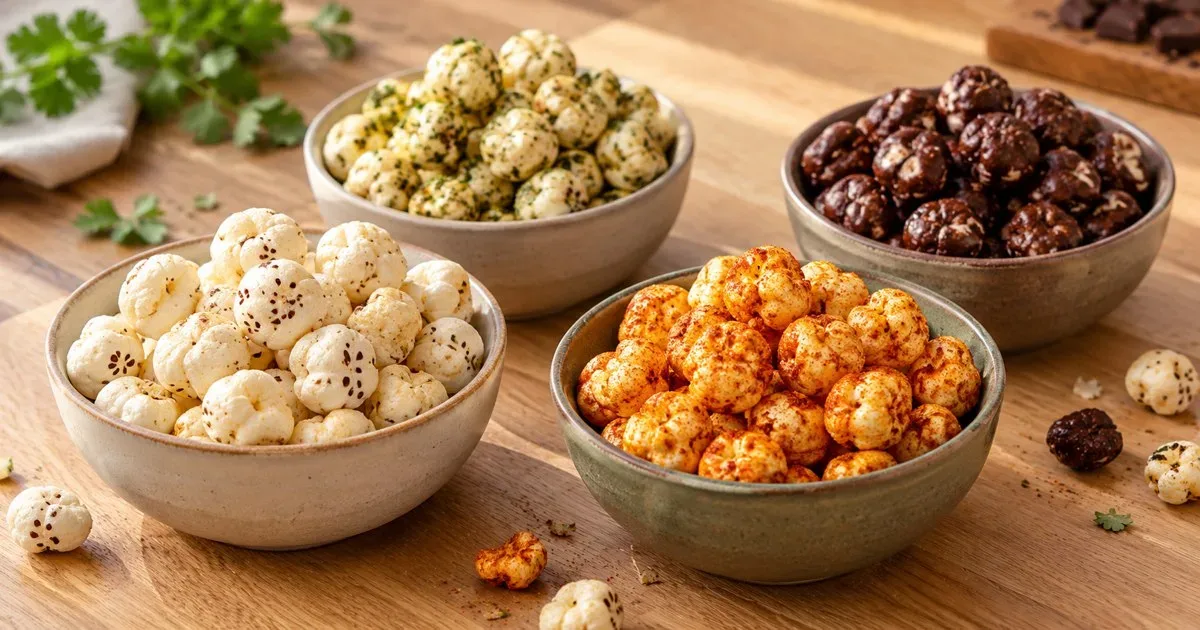
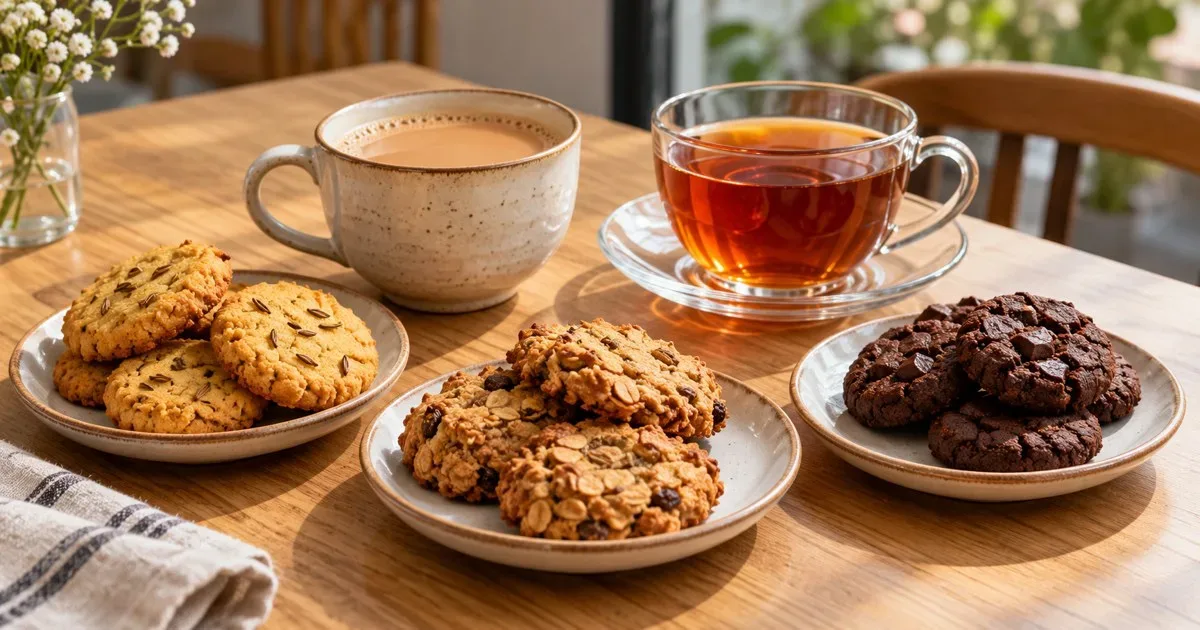
United Foods currently lists Himalayan Salt Makhana, several other makhana flavours, and cookies including Oat Jaggery Cookies. These are possible components to discuss, rather than a preconfigured office box.
- A milder savoury option: useful as one choice in a mixed selection.
- A bolder flavour: include it when your group enjoys more strongly seasoned snacks.
- A sweet option: a cookie format can give the assortment a different taste and texture.
- A clearly identified alternative: select it using verified ingredient information and the needs communicated by your team.
Avoid assigning health benefits to the whole box simply because it includes oats or makhana. Choose products for the occasion and keep any product claims grounded in the current label and approved information.
Review ingredient information before finalising the mix
Ask employees about preferences and any requirements relevant to the selection process. Request current ingredient and allergen information from the supplier, and keep it accessible when food is distributed.
Preserve the original labels on individual packs wherever possible. If the plan involves serving from larger packs, decide how people will identify each product and access its information. Do not describe a mixed assortment as meeting a particular dietary requirement unless the selected products and handling arrangements support that description.
If one flavour or ingredient is unsuitable for part of the group, agree a specific alternative. Record the substitution in the order rather than relying on an informal instruction that may be missed during packing.
Estimate quantities using attendance and allocation
Base your first calculation on a defined distribution plan. A simple formula for individually allocated items is:
Total snack units = expected attendees × units allocated per person × covered sessions.
For example, a hypothetical workshop with 32 attendees, two snack units per person and one covered session needs 64 units. That is an allocation example, not a recommended daily serving. If you decide to add a contingency, show it as a separate quantity so the reason for the extra stock remains clear.
| Planning item | Illustrative quantity | What to confirm |
|---|---|---|
| People attending | 32 | Confirmed attendance for the session |
| Snack units per person | 2 | What counts as one supplied unit |
| Covered sessions | 1 | Whether other breaks need separate stock |
| Total planned units | 64 | Flavour split and pack configuration |
| Additional contingency | To be decided | Reason and quantity recorded separately |
The word “unit” needs agreement. It might mean one sealed packet, one multipack or a specified portion. Confirm net weight, pieces per pack where applicable, and packs per carton before turning the plan into a purchase order.
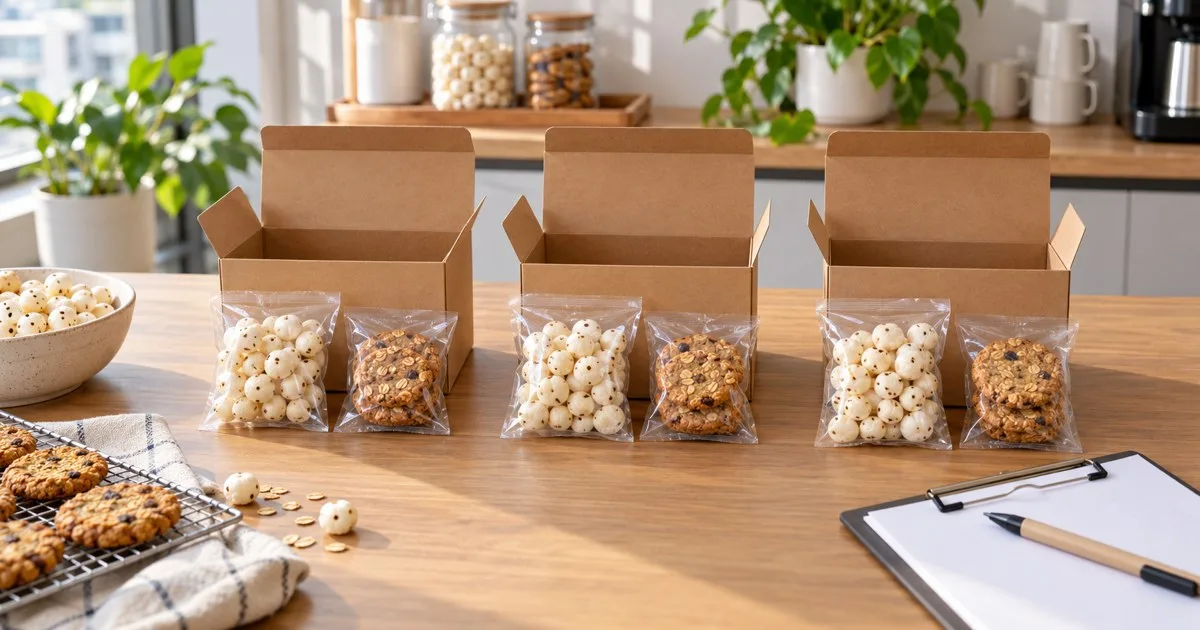
Match packaging to distribution
Ask what formats are available for the exact products you want. Do not assume that every flavour can be supplied in the same packet size or that assorted cartons are available at every quantity.
For individually distributed snacks
Confirm the number and size of sealed packs, the information on each label and how the items will be grouped. If an outer gift box is required, clarify who sources, assembles and checks it. Include any artwork or branding requirement in the quotation request.
For shared service
Check whether the supplied pack can be resealed and plan suitable clean, dry serving equipment. Follow each product's storage and after-opening instructions. A shared bowl may be convenient during a meeting, but the remaining stock still needs appropriate handling.
For multiple offices
Prepare a location-by-location quantity list. Confirm delivery addresses, receiving contacts and the date by which each site needs the snacks. Keep any site-specific substitutions visible so that the right assortment reaches the right team.
Compare the complete quotation
A useful quote states the product, flavour, pack size, quantity and delivery basis. Clarify whether the price includes outer cartons, individual boxes, assembly and any branding that you requested.
Compare like-for-like configurations. A price per large pack cannot be treated as a price per individually distributed snack without knowing what additional portioning or packaging is needed. Keep unconfirmed charges marked as pending rather than entering zero.
For recurring pantry orders, separate the first-order requirement from an estimated repeat volume. Confirm minimum quantities, quote validity and delivery arrangements for the actual order you are ready to place.
Use the first order to improve the second
After the event or trial period, count the stock remaining by product and ask for short feedback. Separate low demand from a distribution issue: a packet left in an unopened carton is different from a flavour people tried and declined.
For a shared pantry, record the period covered and actual office attendance. Adjust the next order using those observations. Avoid turning a one-off event's consumption into a permanent weekly forecast without checking the difference in context.
A small reorder record can include the product, units received, units remaining, feedback and next-order decision. This keeps the process practical even when a different administrator handles the next purchase.
Send United Foods a clear office-snack enquiry
Prepare a short brief with the occasion, expected recipients, preferred products, quantity allocation and destination. State whether you need sealed product packs only or want to discuss an assembled box concept.
- Occasion and intended distribution date.
- Number of recipients or sites.
- Preferred products and any agreed alternatives.
- Required pack format and total units.
- Current ingredient and allergen information needed for review.
- Delivery locations and any outer-box or branding request.
Explore the current United Foods range and send your bulk enquiry. Ask the team to confirm available configurations and services before presenting a final box design to employees or clients.
Keep the first assortment straightforward
A well-planned office snack order has a clear purpose, a measured quantity and an assortment the team can identify. Start with a manageable selection, verify the packing details and use the first distribution to inform the next purchase. That makes snack ordering easier to repeat as attendance and preferences change.